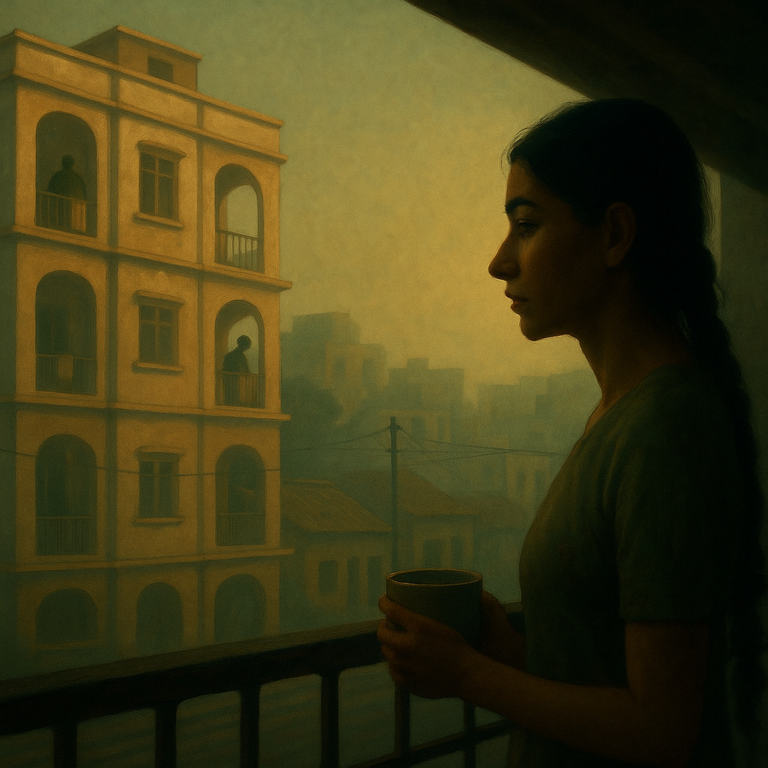
Chapter 1: The Storm and the Question
The head of the village looked up as lightning lit up the night sky and the vast ocean before him. His frown deepened further distorting his already heavily wrinkled face. In all his inordinately long life, he had never seen anything like it.
“Baba, what do you think? What should we do?” Kaashi, his thirty year old grandson, placed a hand on Phoola’s shoulders as the lightning faded, swallowing the question before it could find an answer.
Phoola, Kaashi, and the ninety-eight other souls of the remote village of Samudrapuri huddled beneath the sloping roof of the communal hut, their eyes fixed on Phoola. For three days, the rain had fallen without pause, drumming on the thatch above them. Outside, water crept higher with every hour— swallowing houses, and inching toward the heart of the village.
“Baba…” a woman’s voice broke the silence, soft but trembling. “Do you think the village will drown?”
Another voice followed—a man in a soaked dhoti and clinging vest, eyes wide with worry. “Shouldn’t we move to higher ground, Baba? Before it’s too late?”
Phoola, whose back had been bent from waist up, as if locked by some mischievous village kid while he genuflected, strained his head to look up. As the lightning struck again, he turned around and addressed the people gathered.
“This will pass. We will make our way through it.” His voice trembled like a cart rolling across a bumpy field.
“But baba, it has been three days.” Kaashi replied gently. “We have lost all our boats. Kishan has already lost his house to the sea. Mangal and Madhav’s house is flooded.” As if Phoola had not understood the seriousness of the situation the first time.
“Maadhav, Mangal and Kishan had made their houses on lower ground, knowing very well that it was dangerous. Everyone in the village had explained this to them, but they did not listen. It is their fault.” Phoola’s voice, usually calm, cracked with something sharper—grief hiding beneath anger.
These were his people. He had watched their children grow, watched their walls rise from earth. And now, all he could do was mourn what the sea had taken.
“Baba, the government official who came before the rains started – he said it would rain for fifteen days. He warned that if we don’t vacate this place, we will drown with the village. We are worried baba.” The short, stout and bald Mohan, stood in front of Phoola, with his hand folded, pleading with the old leader.
“Baba, the relief camp is not very far. He even offered to help us build our huts there.” Nirmala, Mohan’s wife, pitched in. Her voice crackling against the pattering rain.
Exhausted and sleep-deprived, Phoola raised a trembling hand toward Kaashi.
Kaashi stepped forward without hesitation, offering his shoulder. Gently, he helped the old man lower himself to the ground.
“My dear people, I am old. I have walked on these lands more than anybody present here. I have scraped my knees on this land as a child.I whispered to the trees in the jungle as a boy. And in my youth, I rowed in the sea, listening to the rhythm of the waves like a heartbeat.
The sky, the sun, the moon, the stars – they speak to me still, like old friends.
I have been a friend and a leader to your fathers and mothers.I am a part of this village in more ways than one.
My only purpose in life has been to secure the safety of Samudrapuri. I know I am old and that many of you question my choice. And reasonably so. Even I haven’t seen rains like this in my life.”
Phoola coughed as he finished speaking, his voice unsteady with age. Yet, he gathered himself—doing his best to speak with the quiet confidence only a man shaped by decades of leadership could carry.
“And so,” he continued, “I believe it is my duty to explain to you the reason for my decision to stay. I will tell you a story. A true story that happened to me.
If after hearing this story you still choose to leave, I will not stop you.” Phoola paused.
The lightning thundered with a roar stretching miles across the sea. The rain still pelting with vengeance.
“Shrabani was still in her mother’s womb when this happened. Kalia was born a year later. In the next 5 years Kaashi, Mahesh, Suraiya, Ganpat and Umesh were born.” He pointed at each one of them while taking their names.
“I knew their parents personally. I am sure all of you know this.
But what you do not know is….that I knew their parents’ parents too” He paused again, letting the silence weigh heavy.
A pause – to take a breath, or perhaps to remember the past that seemed long, long ago to him.
The crowd on the other hand did not know how to react. Some did not understand what he had just said. Others assumed it was the rambling of old age. While the remaining thought that he was joking.
But none of them spoke. Not a single word. The silence spoke on their behalf. And Phoola heard it.
“I know what I just said might not be clear to everyone. So let me say it plainly – I have lived with not just your parents but your parent’s parents as well.”
This time the silence was from the clarity of the revelation.
“Baba, how is that possible? This would make you more than 100 years old.” Kaashi finally broke the silence, his voice laced with disbelief.
“One hundred and fifty,” Phoola corrected softly. “Not a hundred.”
He paused, then added, “And it is possible… because of a medicinal herb. A strange plant called Dhirgayush.”
“Baba, what are you saying?” Kaashi asked, his brows furrowed, still struggling to understand.
Phoola shifted where he sat, then slowly reached out a hand. Kaashi rose at once and helped him to his feet.
As Phoola stood, the rest of the villagers instinctively moved to rise as well—but he raised a hand, gently motioning for them to stay seated. They obeyed in silence.
Chapter 2: The Story Begins
It was a day like any other in the village of Samudrapuri. Ten-year-old Phoola darted through the jungle that bordered the village, just beyond the neatly arranged huts. Fifty huts stood in perfect formation—rows and columns laid out with equidistant care, forming a tidy square. At the very center, a communal hut was under construction, meant to be a gathering place where villagers could socialize and make important decisions. Dense jungle surrounded the village on all sides, except to the south, where the sea lay just five hundred meters beyond the last hut. The men would venture there to fish, while the women cooked, and the children played freely.
It was during this playtime that Phoola ran through the clearing, clutching a makeshift leaf ball, with ten other children from the village chasing after him. The game was simple: one child—the runner—would grab the ball and take off, while the others—the chasers—counted to ten before giving chase. The runner’s goal was to avoid getting caught; the first chaser to tag him would become the next runner. The game only ended when the runner was caught or when exhaustion overtook one of the players. That day, no one had managed to catch Phoola.
“Bhola, run! It’s the fourth time Phoola’s the runner. We can’t let him go again—we have to catch him!” Krishna shouted to his friend running beside him.
“I have an idea,” he added. “There’s a big tree up ahead. Three of you flank him from the left just after that tree—he won’t see you coming.”
At Krishna’s signal, three children veered left while the others continued straight behind him. Just as Krishna had predicted, the big tree appeared ahead of Phoola after a short sprint. Phoola leapt over a fallen log and raced straight toward it. The moment he passed the tree, the three children sprang out from the left. But Phoola, agile and alert, lunged forward and narrowly escaped—causing the trio to crash into the rest of the chasers.
As the chasers tumbled to the ground, Phoola skidded to a stop and turned around.
“Ha! Ha! Ha! Krishna, I’m sure this was your idea!” he said, panting and laughing at the same time.
The chasers got up, dismayed by yet another failed attempt, brushing leaves and twigs from their clothes.
“Phoola, this isn’t fair. I’ve been the chaser for the last three rounds. You’re just unbeatable today!”
“Ha! Ha! Ha!” Phoola laughed, still catching his breath.
“You cannot, Dhanraj.” The children froze—someone had spoken in hushed tones, just beyond the trees.
“Dhanraj, you know how Satyaguru is. He’ll never allow this to happen.”
“I know, Mahesh, I know… but I must.”
Phoola and the others immediately recognized the voices: Dhanraj and Mahesh—Phoola’s father and uncle.
Before Mahesh and Dhanraj could say anything more, one of the children sneezed—loud enough for the two men to realize they weren’t alone. Without a word, they quickly left the spot.
Phoola, as confused and concerned as the rest of the group, stood in silence. After a brief exchange of glances, the children agreed that whatever they’d overheard was beyond their understanding—so they decided to resume the game.
Chapter 3: The Forbidden Dream
The next day, Krishna and Phoola were taking a long walk along the edge of the village.
“Krishna, I’m worried about my father,” Phoola said, finally bringing up the conversation they had overheard the day before.
“What do you think they were talking about?” Krishna asked, nudging him gently.
“I don’t know,” Phoola replied. “But Baba has been acting strange for a while now. He talks about the lands beyond the sea.”
“You know Satyaguru is strictly against even thinking about such things, right?” Krishna said. “You know how powerful he is. Even the jungle bows to him. They say the trees carry his voice across the land and whisper back into his ears. The moon, the sun, and the stars are his friends—they come to pay him respect. The animals are his guards, and they do his bidding.”
“I know,” Phoola murmured. “But still… I wonder—what could be so wrong about just thinking of it? What could possibly go wrong?”
The innocent question hung in the air as Phoola looked to his childhood friend for an answer.
Chapter 4: The Chosen One
“Jai Bhavani!”
A man in a weathered lioncloth roared, his voice echoing across the village temple as all of Samudrapuri gathered around him.
“I shall name the girl Bhavani. She will radiate celestial energy until her last breath and shall bring great fortune to this village.”
With that, the old man lifted the ten-year-old Bhavani high above his head, presenting her to the heavens—and to the village—as a divine gift to their community.
“Jai Bhavani! Jai Bhavani! Jai Bhavani!”
The villagers chanted in unison as the priest held little Bhavani high. This time, it wasn’t just for the people—it was for the moon to witness, for the sun and stars to take note, for the forest to acknowledge, and even for the gods to accept: Bhavani now belonged to his clan, and none—not even the divine—could undo it.
He slowly lowered the child and handed her back to her parents, who had remained kneeling before him, hands folded in absolute, unquestioning faith in their savior—Satyaguru.
Satyaguru wore a thick black beard that reached his torso. His frame, like most men in the village, was lean and agile—built to survive, built to endure, and if needed, to kill.
He dressed like any other villager—bare-chested, wearing only a worn lioncloth. The only thing that set him apart was the tilak on his forehead. There were no ornaments, no embellishments. Yet, he carried himself with a presence that made him unmistakably different.
Satyaguru was a true resident of Samudrapuri—grounded in its soil, its customs, its rhythms. But when he spoke, it was as though he knew something the others didn’t—something immense, something divine. His face radiated an energy so powerful that when he declared himself a conduit to God, people believed him.
His hazel eyes, like portals to another world, could pierce even the hardest of hearts. His smile—gentle, disarming—could calm a wailing child when even its mother could not. The villagers had seen him appear at their doors in the dead of night when someone was ill, or in pain. He was always there. Always watching. And yet, they knew—he was not to be questioned. When Satyaguru spoke, they listened. And they obeyed.
The crowd had barely settled after the ceremony when Satyaguru raised his hand again. The murmurs quieted instantly. Even the forest outside, it seemed, fell silent. As Bhavani’s parents took her back to the crowd, Satyaguru spoke again.
“There is one more matter,” he said, his voice lower now—but far more dangerous. “A matter that threatens the very soul of Samudrapuri.”
The villagers looked around, uncertain, anxious. A strange stillness hung in the air.
“I have heard,” he continued, “that one among us harbors thoughts that should never be thought. A seed of betrayal.”
Heads turned. Some gasped. Others froze.
“Dhanraj,” Satyaguru called out. His voice didn’t rise—but it cut through the air like a blade. “Come forward.”
From the edge of the crowd, a lean man stepped out. Phoola, barely ten, followed behind his father instinctively. Dhanraj’s face was tight, but he walked with his head held high.
Satyaguru looked at him—not in anger, but in cold disappointment. “Is it true? That you wish to leave this land?”
Dhanraj looked up at the priest. “Yes, Satyaguru. I do.”
A gasp swept through the crowd like a gust of wind.
“I have served this village with my hands and my heart,” Dhanraj said. “But something inside me wants to see what lies beyond the jungle, beyond the ocean. I want to explore. I want to know.”
Satyaguru’s voice was calm, but it held the weight of mountains. “And who gave you permission to dream of lands beyond your ancestors’ fire?”
“No one did,” Dhanraj replied. “And yet I dream.”
Satyaguru stared at him for a long moment, his hazel eyes glinting like fire trapped in glass. Then, he raised his hands and thundered:
“Let it be known! This man has turned his back on Samudrapuri. On the land that fed him, the trees that sheltered him, the sea that gave him life. He disrespects the ancient pact that binds us to this place.”
Two men stepped forward—silent, broad-shouldered, faces set like stone. They took hold of Dhanraj by his arms.
“What are you doing?” Dhanraj demanded, struggling. “Let me go!”
Phoola cried out, rushing to his father’s side, but the priest raised his hand and pointed at Phoola. “Bring the boy too.”
“No! He is a child!” Dhanraj shouted, as 2 more men seized the boy and brought him forward. Father and son side by side.
Satyaguru’s voice rose, not in anger—but in proclamation, like thunder being carved into scripture.
“You wish to walk away from your land, Dhanraj. Then let it follow you. Let it live inside you until your bones turn to dust. From this moment on, you—and your blood—will carry this place in your veins.”
He turned to the crowd.
“Bring Dhirgayush.”
From the side of the temple, a small bowl was brought—its contents glowing faintly, like molten moonlight.
“You shall drink this, both of you. You shall live till the end of time itself. But know this—”
He stepped closer, his voice now a whisper that could silence a storm.
“The day you set foot outside the boundaries of Samudrapuri, your breath will betray you. Your lungs will forget how to hold air. And you will die.”
Phoola whimpered as the bowl was raised to his lips. Dhanraj struggled, but the grip of Satyaguru’s men was iron.
“You cannot do this!” Dhanraj cried.
“I already have.”
One after another, the liquid was poured into their mouths. They coughed, sputtered, tried to spit it out—but the deed was done.
Then Satyaguru turned to the villagers.
“This curse,” he said, “is not for Dhanraj alone. It is for all of us. Every man, every woman, every child born of this soil. The moment we think of leaving, the moment we set foot outside this land—we forfeit the protection of the gods. We walk into death.”
He stepped down from the podium, the silence behind him deeper than any before.
“We do not leave,” he said. “We endure.”
Chapter 5: The Reckoning
The rain continued to lash the ground outside, but inside the communal hut, silence hung heavier than the monsoon air.
Then, a voice broke through.
“Why were we never told this before, Baba?” It was Ganpat, his voice cracking as if the question had been fermenting inside him for years. “We built our lives here… had children, grew old. Why didn’t you tell us sooner?”
Phoola’s eyes did not flinch. “Because until now, the curse was just a memory. A possibility. I never thought the day would come.”
“Baba, look outside! The water’s already in our homes. What are we waiting for—another house to drown?” Kalia stood up, water dripping from the ends of his hair.
A murmur rippled through the crowd. The calm was breaking.
“How can we trust something we’ve never seen, Baba? This flood we can see. It’s right here. This curse—who even knows?” Mahesh’s son shouted from the back.
Phoola’s hand trembled but he did not lower his gaze. “And yet you believe I have lived One Fifty years. You believe in the herb. Why is the curse any harder to accept?”
Padma stood now, fists clenched by her sides.
“We believe you, Baba. Of course we do. But belief won’t save us if the flood comes crashing through that door.” Her voice quivered. “Just because the curse exists… doesn’t mean we should die here like animals trapped in a sinking pit.”
Phoola opened his mouth to speak, but it was Mohan who surged forward now, defiant, eyes wide with a cocktail of fear and fury.
“Has anyone actually left the village and died from the curse?” he bellowed. “Tell me, Baba! Who? Give me a name!”
Phoola hesitated.
“They never returned,” he said slowly. “No one who left was ever seen again.”
“That’s not an answer!” Mohan roared. “For all we know, they’re alive. In cities, with lights and dry homes! You hid the truth for decades and now want us to accept death because maybe the curse is real?”
The room broke into murmurs again. Fear was seeping into loyalty now.
Kaashi stood up beside his grandfather, trying to hold the center.
“Baba is not asking us to die,” he said. “He’s asking us to believe that staying might be the only way to live. That’s what Satyaguru said. That we would survive the worst… if we stayed.”
“But is the curse forever?” asked Nirmala softly, the only one still sitting. “Can it not be lifted, now that Satyaguru is long gone? Can’t we undo it?”
Phoola turned to her, voice heavy. “No ritual has ever been taught. No prayer left behind. This was not a warning, it was a sentence.”
A child began to cry in the corner. The wind howled outside, as if nature herself had something to say.
“Then let someone go,” said Padma. “Just one of us. Let’s see for ourselves before we all sit here and drown.”
Phoola’s voice dropped, almost a whisper now.
“You’re free to go. All of you. But if the curse holds true… you will not return. And you will not be mourned. Because we will know it was your choice.”
For a long time, no one moved. Phoola remained standing.
The others watched him, torn — between loyalty and logic, between staying and surviving. Some cried. Some argued. But no one else moved.
The rain roared louder than ever before.
Then, slowly, one by one, the villagers sat back down.
Even Mohan. Even Padma. Even Radha.
They sat — not out of surrender, but out of something heavier. Something older. Faith, perhaps. Or the weight of fear passed down like folklore.
Phoola looked at them all, his voice gravelly, exhausted.
“We stay. We survive. That is the promise. The storm may test us, but it cannot break us.”
“We do not leave,” he said. “We endure.”
The lightning flashed.
The wind howled.
And the sea moved closer.
A week later — a national news broadcast
“The prime minister spoke to the opposition leader about the need to reform the education system in the country. He also tried to win over the opposition leader to support his government in passing the national education reform bill.”
“In other news, about 99 people have been declared dead in the tribal village of Samudrapuri. It is reported that torrential rains from the cyclone ‘Dipankar’ wreaked havoc in this southernmost village of India.”
“Survivors say a village elder convinced the residents to stay, despite warnings to move to higher ground. Sadly, the entire village of Samudrapuri has now submerged under water.”
Some say an old man was seen walking alone by the shore days later
Back hunched, eyes hollow.
No one knows how he survived.
But in the silence that followed, only Phoola remained.
Cursed not to drown, but to remember.
“He stood where the village once breathed,
whispering names into the sea
each one a ripple,
each one a grave,
and none of them reaching back.”